
Download Brochure
Check out the program and fee details in our brochure

Thanks for your interest!
An advisor will be reaching out to you soon.
Not able to view the brochure?
View Brochure

Get details on syllabus, projects, tools, and more

Application closes Today

Ranked among Top 10 Best Online DBA Degrees of 2024 by Forbes

Awarded Top-Tier Global DBA Ranking by CEO Magazine

World Education Services (WES) Recognized

No Masters required

Flexible Learning Format - 100% Online

Get Alumni Status from Walsh College

Quick Application with No GRE/GMAT or TOEFL Requirement

Capstone Project (Year 1) followed by Thesis (Year 2)
This DBA in AI & ML syllabus, developed by esteemed experts from Walsh College, offers comprehensive insights into AI and Machine Learning. A unique research-led curriculum which allows you to work with dedicated guidance from top faculty and industry experts to help you master the AI & ML domain.
Read more
Year 1
Term 1
IT 721 : APPLIED RESEARCH TOPICS IN DEEP LEARNING THEORY & PRACTICAL APPLICATIONS:
In this course, you will master CNNs, RNNs, LSTMs, autoencoders, and state-of the-art generative models like GPT, PaLM, CLIP, and DALL·E and gain the industry-critical skills of transfer learning, prompt engineering, and RAG & LoRA fine-tuning to create domain-specific AI systems ready for real-world impact.Database storage technologies have transformed into complex systems that support knowledge management and decision support systems. This course takes a look at the foundations of database storage technologies. Students will learn about database storage architecture, types of database storage systems (legacy, current and emerging), physical data storage, transaction management, database storage APIs, data warehousing, governance and big data systems. The student will tie this all together to see how database storage technologies apply to data analytics.
Database storage technologies have transformed into complex systems that support knowledge management and decision support systems. This course takes a look at the foundations of database storage technologies. Students will learn about database storage architecture, types of database storage systems (legacy, current and emerging), physical data storage, transaction management, database storage APIs, data warehousing, governance and big data systems. The student will tie this all together to see how database storage technologies apply to data analytics. Upon successful completion of this course, you will be able to:
Term 2
BTC 771 : AI STRATEGY FOR LEADERS:
The course integrates real-world case studies from industry leaders such as Tesla, Amazon, JPMorgan Chase, and Microsoft, providing students with insights into AI successes and challenges. Through case study analyses, discussions, and practical assignments, students will develop leadership strategies for AI integration, ensuring responsible and effective AI adoption in their organizations.
QM 625 : Mathematics of Artificial Intelligence & Machine Learning
This course introduces and explains the fundamental mathematical concepts that form the backbone of artificial intelligence and deep learning. It emphasizes a strong understanding of linear algebra and analytic geometry, which are essential for building and optimizing AI models. Learners will explore how these mathematical principles directly apply to modern algorithms and neural networks. By the end of the course, participants will gain the analytical skills needed to interpret and implement AI techniques effectively.
Course Learning Outcomes:
Upon successful completion of this course, students will be able to:
Term 3
QM 625 : CAPSTONE PROJECT:
The Capstone Project provides the opportunity for integrating program learning within a project framework. Each student identifies or defines a professionally relevant need to be addressed that represents an opportunity to assimilate, integrate or extend learning derived through the program. The student will work with the Capstone Project Mentor to develop a proposal. After review and approval by the Capstone Project Mentor, the student will be authorized to complete the project. The student will present the completed project at the end of the semester. Upon successful completion of this course, you will be able to:
IT 720 : APPLIED RESEARCH IN NATURAL LANGUAGE PROCESSING: (Only for Doctorate learners)
This course is designed to provide students with advanced knowledge and practical skills in natural language processing (NLP) research and applications. Students will delve into cutting-edge techniques, methodologies, and tools used in NLP, with a focus on applied research and real-world use cases. Through a combination of lectures, hands-on projects, and literature review assignments, students will explore topics such as text classification, sentiment analysis, named entity recognition, machine translation, question answering, and more. Emphasis will be placed on understanding the underlying algorithms, evaluating model performance, and conducting empirical studies to address real-world NLP challenges.
Upon successful completion of this course, students will be able to:
Term 4
RES 712 : QUALITATIVE AND EXPLORATORY RESEARCH METHODS
This course explores non-statistical forecasting and other qualitative research methods. Qualitative research methodologies have become more prevalent in research as a viable and valid form of inquiry, especially as they pertain to human behavior in organizations. Qualitative research techniques examined include ethno methodology; grounded theory; and phenomenological research. Nonparametric statistical analysis will also be examined. By the conclusion of this class, you will gain a solid foundation regarding the qualitative research approach and its various traditions along with their theoretical and applied constructs. This will allow you to prepare a qualitative problem for research as well as structure a valid qualitative research design for conducting the actual research itself (i.e., your doctoral dissertation or future research problems in your area of interest or specialization).
RES 713 : QUANTITATIVE RESEARCH METHODS I DATA MANAGEMENT AND NON-EXPERIMENTAL:
This course is a combination of quantitative research methods, multivariate statistics, and forecasting. The course assumes the doctoral student has had a graduate-level statistics/quantitative methods course covering parametric statistics and hypothesis testing.
DOCTORAL RESIDENCY I: This course is the first of three residencies. The residencies occur simultaneously with coursework throughout the student's doctoral journey. The intent of a residency experience is to provide students with a chance to connect directly with faculty/mentors and fellow students within the doctoral program. Students will attend information sessions, meet with faculty/mentors regarding subject matter and research methodology experts, and present their problem/purpose statement to a review board for feedback and direction.
Year 2 (Doctorate)
RES 714 : QUANTITATIVE RESEARCH METHOD II
This course is designed to build an advanced body of knowledge (BOK) that will allow students to utilize an extensive array of complex statistical models, tools, and software applications in the analysis of numerical data. Additionally, students will be able to use these advanced techniques to perform predictive analytics. This course is designed to build upon the non-experimental methods and techniques explored in RES 713. The comparative method will be explored along with the issue of ecological inference, aggregate vs. group assessment, and data reduction. Students will then assess the three main traditions associated with the experimental approach-pre-experiment, quasi-experiment, and the "true" experiment.
DOCTORAL RESIDENCY II
Transition from coursework to dissertation research. Develop your dissertation proposal, gain ethical research approval, and begin collecting data for your study.
DOCTORAL RESIDENCY III
Advance your dissertation research and writing. Analyze your data, draft your dissertation chapters, and receive ongoing feedback from your dissertation committee.
DISSERTATION COURSES
This dissertation program provides the structure and resources to complete your doctoral research and successfully defend your thesis.
Degree from Walsh College
DBA cum Masters Dual Degrees from Walsh College

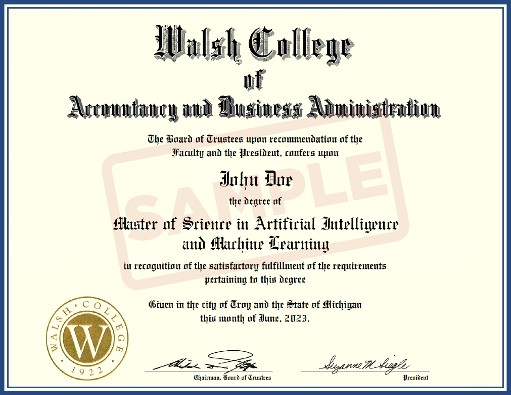
* Image for illustration only. Certificate subject to change.

For Best Online DBA Programs in Forbes

Global DBA Ranking by CEO Magazine

By The Higher Learning Commission (HLC)

Join exclusive career fairs and hackathons with GL eXcelerate

Access our Job Boards where our team posts job opportunities from top organizations

Get 1 : 1 career mentoring with LIVE online sessions with industry professionals

Gain industry insights and set your career goals with mentorship

Review your CV and LinkedIn profile with experts to make your portfolio look unique

Participate in mock interviews & get guidance from our alumni currently in roles you aspire for
Our admissions close once the requisite number of participants enroll for the upcoming batch . Apply early to secure your seats.

Apply by filling a simple online application form.

Go through a screening call with the Admission Director’s office.

An offer letter will be rolled out to the select few candidates. Secure your seat by paying the admission fee.
Note: Learners enrolled in the PGP AIML program who have achieved a minimum CGPA of 2.75 are eligible for both the first and second years of the program


2025-05-15 08:33:42 UTC

2025-05-14 13:36:35 UTC

2025-05-14 13:35:03 UTC

2025-05-14 13:32:43 UTC

2025-05-14 12:42:54 UTC

2025-05-14 12:30:41 UTC


Enter your registered email and we'll send you a link to change your password.