
Elevate Your Career with AI Skills
Certificate Program in Artificial Intelligence: Applied ML, GenAI, and Agents
 Application closes on
5th Mar 2026
Application closes on
5th Mar 2026

 Speak with our expert
+1 410 883 8765
Speak with our expert
+1 410 883 8765





Learn more about the course
Get details on syllabus, projects, tools, and more

Certificate Program in Artificial Intelligence
Application closes 5th Mar 2026
Why Artificial Intelligence?
-

AI is reshaping how businesses operate
AI is driving structural changes across functions. Organizations are scaling AI to unlock value.
-

Build the most in-demand skill today
AI isn’t replacing jobs; people who use AI are. Stay relevant and future-proof your career.


PROGRAM OUTCOMES
Elevate your skills in Applied AI
Learn techniques to extract actionable insights and solve complex business challenges
-

Develop practical LLM workflows using prompt engineering, fine-tuning, RAG systems and AI agents.
-
Understand core AI concepts, identify problems, and associated ethical implications.
-
Understand NLP, GenAI, and experiment with models like Transformers & Stable Diffusion.
-
Construct and train neural networks and understand architectural differences.
-
Implement and evaluate supervised learning algorithms and anomaly detection techniques.
-
Apply key Python libraries to prepare data for analysis and modeling.
Earn a Certificate of Completion from Johns Hopkins University
-

#6 National University Rankings
U.S. News & World Report, 2025
-
#13 Best Global University
U.S. News & World Report, 2024
-
#1 Computer Information Technology
U.S. News & World Report, 2025
-
#1 Biomedical Engineering Program
US News and World Report

KEY PROGRAM HIGHLIGHTS
Why choose the Applied AI program
-

Learn from a top-ranked university
Learn from expert JHU faculty and industry leaders.
-

Industry-aligned curriculum
Learn the foundations of Python, GenAI, and Deep Learning, gain valuable insights, and apply your skills to transition into AI roles.
-

Hands-on learning
Drive business value by building practical AI solutions through hands-on projects and real-world case studies.
-

Live masterclasses and mentorship
Experience live mentorship by industry experts and live faculty-led masterclasses for structured, personalized learning.
-

AI-assisted learning
AI-powered tools support learning content and practice activities to enhance learning efficiency and engagement.
-

Dedicated support
Access a dedicated Program Manager and Academic Learning Support, which includes discussion forums and peer groups.


Skills you will learn
GENERATIVE AI
AGENTIC AI WORKFLOWS
RETRIEVAL-AUGMENTED
GENERATION PROMPT ENGINEERING
MACHINE LEARNING
STATISTICAL ANALYSIS
GENERATIVE AI
AGENTIC AI WORKFLOWS
RETRIEVAL-AUGMENTED
GENERATION PROMPT ENGINEERING
MACHINE LEARNING
STATISTICAL ANALYSIS
Advance your career with AI
-
AI top priority
For 75% companies
-
GenAI Job Surge
411% rise in roles
-
AI Skills Pay
56% premium wages
-
Up to $ 150K
avg annual salary
Careers in Artificial Intelligence:
Roles you can unlock with Artificial Intelligence skills
-
AI Specialist
-
AI Analyst
-
Machine Learning Engineer
-
AI Solutions Associate
-
NLP Engineer
-
AI Product Manager
-
AI Strategy Consultant
-
Prompt Engineer
Our alumni work at top companies
- Overview
- Learning Journey
- Curriculum
- Projects
- Tools
- Certificate
- Faculty
- Mentors
- Career Support
- Fees
- FAQ

This program is ideal for
Working professionals at various stages of their careers looking to advance their knowledge and skills in AI.
-
STEM graduates
Looking to secure their first role in the data and AI industry, with a focus on building a strong foundation in AI.
-
Early to mid-career
Seeking to transition into AI roles by acquiring the skills necessary to navigate and excel in this fast-evolving field.
-
Senior professionals
Looking to upskill in AI and deepen their understanding of advanced AI concepts and applications relevant to their industry.
-
Tech leaders
Who want to leverage AI for strategic planning, innovation, and data-driven business decision-making
Experience a unique learning journey
Our pedagogy is designed to ensure a holistic learning experience
-

Learn from world-renowned faculty
Learn critical concepts through live masterclasses and recorded video lectures by JHU faculty
-

Engage with your mentors
Clarify your doubts and gain practical skills during weekly live sessions with industry experts
-

Work on hands-on projects
Work on projects to apply the concepts & tools learnt in the module
-

Get personalized assistance
Our dedicated program managers will support you through your learning journey




PROGRAM CURRICULUM
The curriculum is designed by the faculty of Johns Hopkins University and leading industry practitioners. It is taught by best-in-class professors, practicing industry experts, and professionals from leading global companies.
-
Self-paced
Modules
-
Live
Faculty-led masterclasses
-
Live
Mentorship sessions
PRE-WORK
This module will help learners navigate the AI landscape by identifying key problems and solution spaces, enabling businesses to leverage AI technologies effectively, acquire fundamental programming skills in Python to build the necessary foundation to develop AI solutions to support business initiatives, and apply foundational concepts of probability and statistics as a foundation to analyze data and inform strategic decision-making. AI Landscape - Problems and Solution Spaces Introduction to Python Fundamentals of Probability and Statistics
MODULE 01: PYTHON FOR DATA-DRIVEN INSIGHTS
This module focuses on building a strong foundation in data analytics and applying the ROAD framework to identify and solve key business challenges using data-driven approaches. Learners will also utilize Python for data transformation and feature engineering to prepare datasets, and conduct exploratory and statistical analysis to uncover trends and patterns in data, enabling informed business decisions and strategic planning. Introduction to Data Analytics Python Fundamentals for AI Python for Data Transformation and Feature Engineering Exploratory Analysis and Visualization Introduction to Statistical Analysis Learning Break Project 01
MODULE 02: APPLIED MACHINE LEARNING FOR PREDICTIVE ANALYTICS
This module focuses on building a strong foundation in core machine learning techniques by exploring supervised and unsupervised learning approaches and their real-world applications. It enables participants to model, classify, cluster, and detect patterns in data using algorithms such as linear regression, decision trees, K-means clustering, and anomaly detection techniques. Learners will also explore techniques for tuning and evaluating these models for optimizing predictive performance. Regression Techniques Classification Methods Clustering Algorithms Anomaly Detection Project 02 Learning Break
MODULE 03: NEURAL NETWORKS AND COMPUTER VISION
This module builds a strong foundation in deep learning and modern AI by exploring neural network models. Learners will explore the fundamental concepts of neural networks and their application to classification tasks, examine the unique architecture of CNNs and their applications, such as object detection and facial recognition, understand the principles behind diffusion models, and how to generate high-quality images from textual descriptions. Neural Networks for Classification CNNs for Vision Applications Image Generation with Stable Diffusion Project 03 Learning Break
MODULE 04: GENERATIVE AI FOR NLP
This module builds a strong foundation in NLP and Generative AI for text-based applications to enhance communication and create innovative solutions. Participants will implement prompt engineering and retrieval-augmented generation (RAG) techniques to improve response accuracy and relevance in AI-driven systems, and design and build agentic AI workflows that automate tasks and optimize processes. NLP and Generative AI for Text Analytics Retrieval-Augmented Generation for Contextualized Q&A Building Agentic AI Workflows Project 04
SELF PACED MODULES
The courses below are self-paced (released after the core learning journey).
MODEL DEPLOYMENT (LIVE MASTERCLASS ONLY)
REINFORCEMENT LEARNING
RECOMMENDER SYSTEMS
DIMENSIONALITY REDUCTION
Work on hands-on projects and case studies
Gain practical, hands-on skills and leverage AI to solve business challenges.
-
Hands-on
projects
-
Real-world
case studies
-
In-demand
tools and techniques

RETAIL, E-COMMERCE
Retail Order Query Chatbot
Description
Develop an AI-powered ‘secretary’ that assists users in managing emails more efficiently by highlighting the most urgent messages, summarizing email threads, and improving overall productivity. The project aims to leverage Generative AI models for classifying, prioritizing, and summarizing emails to provide concise, actionable insights for users.
Skills you will learn
- Large Language Models
- Prompt Engineering
- AI Agents
- Context-Aware Chatbots
- Order Tracking Automation
- Python
E-COMMERCE, DIGITAL MARKETING
Measuring What Drives Online Purchase Decisions
Description
Develop a Generative AI system that automates the drafting of NIH research proposals by aligning ideas with Notices of Funding Opportunities (NOFOs) and generating high-quality, structured content.
Skills you will learn
- Statistical Analysis
- Statistical Testing
- Data-Driven Decision Making
- Python

HEALTHCARE, MEDICAL ANALYTICS
Predicting Cardiovascular Disease Risk
Description
Develop an AI-driven predictive model to identify high-risk loan applicants with greater accuracy. By analyzing applicant data, credit scores, and loan types, the model reduces subjectivity in loan approvals and flags potential defaults before they occur.
Skills you will learn
- Decision Trees
- Ensemble Learning
- Random Forests
- Model Tuning
- Model Evaluation
- Classification
- Python

MARKETING, CREATIVE TECHNOLOGY
AI-Powered Visual Content Generation System
Description
Explore how to build an AI solution that generates personalized images from text to support creative campaigns for brands and NGOs.
Skills you will learn
- Generative AI
- Visual Content Generation
- Prompt Engineering
- Image Generation
- Stable Diffusion
- Python


Master in-demand AI & ML tools
Gain hands-on experience with 20+ tools and techniques
-

Python
-

Pandas
-

NumPy
-

Scikit-Learn
-

Hugging Face
-

Llama Cpp
-

ChatGPT
-
ChatGPT API





Earn a certificate of completion from Johns Hopkins University
Get CEUs and a globally recognized credential from a top U.S. university and showcase it to your network.
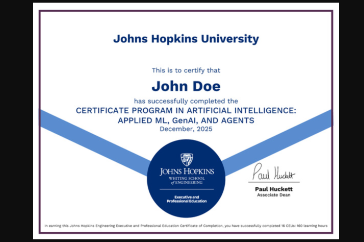
* Image for illustration only. Certificate subject to change.
Meet your faculty
Learn from renowned faculty with expertise across AI, machine learning, and applied analytics.
-

Dr. Ian McCulloh
Manager, AI Continuing and Exec Ed, Johns Hopkins University
Served as Chief Data Scientist and MD of AI at Accenture Federal Services
Author of three books and over 100 peer-reviewed papers
Know More
-
.jpg "Dr. Anthony (Tony) Johnson - Faculty Director")
Dr. Anthony (Tony) Johnson
Senior Professional Staff Member and Research Scientist, Applied Physics Laboratory, Whiting School of Engineering, Johns Hopkins University
Former AI researcher at HEC Montréal specializing in deep learning
Expert in NLP, computer vision, and meta-learning for real-world AI tasks
Know More


.jpg "Dr. Anthony (Tony) Johnson - Faculty Director")

 LinkedIn Profile
 University Link
Interact with our mentors
Interact with dedicated and experienced AI experts who will guide you through your learning journey
-

Prabhat Bhattarai
 Data Scientist Apple
-

Priyanka Singhal
Assistant Vice President (AI Research), US Bank
-

Vinicio Desola Jr
Senior AI Engineer Newmark
-

Marcelo Guarido de Andrade
Research Assistant at University of Calgary University of Calgary
-

Omid Badretale
Senior Research Data Scientist | Alternative Data RBC Capital Markets
-

Pankaj Kumar
Data Science Manager Republic Finance
-

Sundeep Pothula
Product Data Scientist Moveworks











Get your dream job with dedicated career support
-

1:1 career sessions
Interact personally with industry professionals through career mentoring sessions to get valuable insights and guidance
-

Interview preparation
Gain insights into what recruiters look for. Access career prep material and practice with AI-powered mock interviews.
-

Resume & profile review
Polish your resume using an AI-assisted builder to better showcase your skills and experience.
-

E-portfolio
Build an industry-ready portfolio to showcase your mastery of skills and tools




Course Fees
The course fee is USD 3,700
Advance your career
-

Understand core AI concepts, identify problems, and associated ethical implications
-
Understand NLP, GenAI, and experiment with models like Transformers & Stable Diffusion
-
Implement and evaluate RAG systems to enhance LLM performance through context
-
Develop practical LLM workflows using prompt engineering, fine-tuning, and AI agents


Easy payment plans
Avail our EMI options & get financial assistance
-
INSTALLMENT PLANS
Upto 12 months Installment plans
Explore our flexible payment plans
View Plans
-
discount available
USD 3,700 USD 3,500
USD 3,700 USD 3,550
Third Party Credit Facilitators
Check out different payment options with third party credit facility providers


*Subject to third party credit facility provider approval based on applicable regions & eligibility

Registration process
Our registrations close once the requisite number of participants enroll for the upcoming batch. Apply early to secure your seat.
-

1. Fill application form
Register by completing the online application form.
-

2. Application screening
A panel from Great Learning will review your application to determine your fit for the program.
-

3. Join program
After a final review, you will receive an offer for a seat in the upcoming cohort of the program.


Batch start date
-
Online · 14th Mar 2026
Admission closing soon
Delivered in Collaboration with:

Johns Hopkins University is collaborating with online education provider Great Learning to offer the Certificate Program in Artificial Intelligence: Applied ML, GenAI, and Agents. Great Learning is a professional learning company with a global footprint in 14+ countries. Its mission is to make professionals around the globe proficient and future-ready. This program leverages JHU's leadership in innovation, science, engineering, and technical disciplines developed over years of research, teaching, and practice. Great Learning manages the enrollments and provides industry experts, student counselors, course support, and guidance to ensure students get hands-on training and live personalized mentorship on the application of concepts taught by the JHU faculty.
 Application Closes
5th Mar 2026
Application Closes
5th Mar 2026

Frequently asked questions
What is the Certificate Program in Artificial Intelligence: Applied ML, GenAI, and Agents?
The Certificate Program in Artificial Intelligence: Applied ML, GenAI, and Agents is a five-month online program from Johns Hopkins University’s Whiting School of Engineering. It is designed for professionals and graduates who want to build practical, job-relevant skills in applied artificial intelligence and move beyond theory to real-world implementation.
The program focuses on applying AI techniques to solve business and operational problems. Learners work with real datasets, industry case studies, and hands-on projects while attending live mentorship sessions with industry experts and faculty-led masterclasses from Johns Hopkins University.
What will I learn in this Artificial Intelligence program?
In this program, you will learn to:
- Understand core AI concepts, including Machine Learning, deep learning, and Generative AI, identify industry-relevant, solvable problems, and consider associated ethical implications.
- Apply key Python libraries (NumPy, Pandas) for data loading, cleaning, preprocessing, and feature engineering to prepare data for analysis and modeling.
- Analyze data using statistical methods and create visualizations to effectively communicate business insights across diverse industry scenarios.
- Implement and evaluate supervised learning algorithms (regression, classification), unsupervised learning (clustering), and anomaly detection techniques.
- Construct and train neural networks for classification tasks, including Convolutional Neural Networks (CNNs) for image classification and object detection, with a clear understanding of architectural differences.
- Comprehend fundamentals of Natural Language Processing (NLP) and Generative AI, including hands-on experimentation with models such as Transformers and Stable Diffusion.
- Implement and analyze Retrieval Augmented Generation (RAG) systems to improve language model performance through enhanced contextualization.
- Develop practical Large Language Model (LLM) workflows using Prompt Engineering, fine-tuning, and AI agents for seamless real-world integration.
What are the key features of the program?
The Certificate Program in Artificial Intelligence: Applied ML, GenAI, and Agents offers the following key features:
- Five-month program in an online learning format
- Live masterclasses led by Johns Hopkins University faculty
- Live mentorship sessions with global industry experts
- Recorded video lectures and self-paced learning modules
- Hands-on projects and real-world case studies across industries
- Dedicated support from a Program Manager
- Academic support through the Great Learning community, peer groups, and discussion forums
- A Certificate of Completion with 16 Continuing Education Units (CEUs) from Johns Hopkins University
What is the format and structure of this applied AI course?
The program is delivered fully online through a structured five-month format that includes:
- Recorded, self-paced video lectures
- Live mentorship sessions with industry experts
- Faculty-led masterclasses from Johns Hopkins University
- Hands-on projects and real-world case studies
- Self-paced reinforcement modules
Will I receive learning support during the program?
Yes. Learners receive continuous support throughout the Certificate Program in Artificial Intelligence: Applied ML, GenAI, and Agents. A dedicated Program Manager acts as a single point of contact, helping with scheduling, progress tracking, and access to resources.
Learners also benefit from academic support through the Great Learning community, project discussion forums, peer groups, live mentorship sessions, and faculty-led masterclasses designed to reinforce key concepts.
What is the duration of the Certificate Program in Artificial Intelligence: Applied ML, GenAI, and Agents?
The program is five months long.
What is the weekly time commitment?
Learners are expected to dedicate approximately 8–10 hours per week to complete learning modules, attend live sessions, and work on hands-on projects.
Who are the faculty and mentors for JHU’s Artificial Intelligence course?
The program is designed and delivered by faculty from Johns Hopkins University, with deep expertise in applied AI, machine learning, neuroscience, and analytics.
Core faculty include:
- Dr. Anthony (Tony) Johnson, Senior Professional Staff Member and Research Scientist, Johns Hopkins University
- Dr. Ian McCulloh, Manager of Artificial Intelligence Continuing and Executive Education, Johns Hopkins University
Learners also receive guidance from industry mentors who are experienced AI practitioners from leading global organizations.
Note: Faculty and mentor lists are subject to change based on availability.
How do I earn the AI course certificate?
Upon successful completion of the program, you will receive a Certificate of Completion from Johns Hopkins University, along with 16 Continuing Education Units (CEUs).
The certificate demonstrates practical proficiency in applied AI, machine learning, deep learning, and Generative AI. It adds value to your professional profile by showcasing hands-on experience and real-world application of AI skills.
What sets JHU’s AI program apart from other AI certificate courses?
This program stands out due to:
- Strong focus on applied, real-world AI use cases rather than theory alone
- Live faculty masterclasses combined with industry mentorship
- Hands-on projects across multiple domains, including healthcare, retail, aviation, and marketing
- Coverage of modern AI techniques, including Generative AI, RAG, and Agentic AI workflows
- Personalized learner support throughout the program
What tools and technologies will I use in the program?
Learners work with industry-relevant tools and technologies, including:
- Python and key data science libraries
- Machine learning and deep learning frameworks
- Large Language Models (LLMs)
- Prompt Engineering and RAG frameworks
- Computer vision and Generative AI models
These tools are applied through hands-on projects and case studies.
Who is this program for?
This program is designed for:
- Professionals seeking to transition into AI roles by acquiring the skills and knowledge necessary to navigate and excel in this fast-evolving field.
- Professionals looking to upskill in AI to stay ahead in their careers by deepening their understanding of advanced AI concepts and applications relevant to their industry.
- STEM (Science, Technology, Engineering, and Mathematics) graduates looking to secure their first role in the data and AI industry, with a focus on building a strong foundation of technical skills and practical experience.
*The program enables non-technical professionals to transition into a career in AI and Machine Learning without any prior coding experience.
What is the admission process?
The admission process is conducted on a rolling basis and will be closed once the requisite number of candidates are enrolled.
1. Fill the application form Register by completing the online application form.
2. Application screening A panel from Great Learning will review your application to determine your fit for the program.
3. Join the program
An offer letter will be sent to the selected candidates.
What is the program fee?
The total program fee for the Certificate Program in Artificial Intelligence: Applied ML, GenAI, and Agents is $3,700. Flexible payment options may be available. Please contact a Program Advisor for details on payment plans and financial assistance.
What are CEUs, and how are they useful?
Upon successful completion of the program, you will earn 16 Continuing Education Units (CEUs) along with a certificate of completion from Johns Hopkins University. CEUs are a measure of instructional time and reflect the estimated time an average student will spend completing the mandatory components of a course. CEUs are awarded upon successfully completing all course requirements, which may include assessments, assignments, evaluations, or a final project. Earning CEUs allows professionals to demonstrate their commitment to continuous learning and skill advancement.
What career support will be available with this Artificial Intelligence course?
The program offers comprehensive career resources and guidance designed to help translate program learning into professional advancement.
- Career Preparation Sessions: Includes two sessions focused on exploring ways to apply skills acquired from the program for professional advancement, with strategies for leveraging competencies developed through the program.
- Resume Builder: Access to a resume builder to create professional, impactful resumes aligned with targeted roles.
- Mock Interviews: Unlimited mock interviews powered by AI to practice and refine interview skills.
- Career Preparation Materials: Access to curated interview questions and preparation materials to support readiness for job opportunities.
How can I contact the program team for more information?
For any queries or assistance, you can reach out to the program team at office-apai-gl@jhu.edu or call +1 410 883 8765.


Hey there! Welcome back.


Forgot your password? No problem.

You are already registered. Please login instead.
Login
Forgot Password?
Enter your registered email and we'll send you a link to change your password.